
Description
Nobody sits down one morning and thinks, "our document management is really working well." It just doesn't happen that way. What actually happens is a project stalls because someone saved the wrong version. Or a client asks for a signed contract from eight months ago and three people spend an afternoon digging through email chains trying to find it.
That's the moment most businesses start asking if there's a better way. And there is — a proper DMS on cloud fixes most of those problems without requiring an IT overhaul or a six-figure software budget.
________________________________________
The Real Cost of Poor Document Management
Here's something worth sitting with for a second. Research across multiple industries puts employee time spent searching for documents somewhere between 30 and 40 percent of the working week. Not creating documents. Not acting on them. Just finding them.
That's before you factor in the mistakes. Wrong file sent to a client. Outdated policy document used in a compliance review. An invoice processed twice because two people pulled different versions. These aren't hypotheticals — they happen in real businesses every week, and they add up in ways that are hard to put a number on until something goes seriously wrong.
Regulated industries feel this the hardest. A misfiled record isn't just inconvenient there. It can derail an audit, trigger a penalty, or end a supplier relationship.
________________________________________
What a DMS on Cloud Actually Does
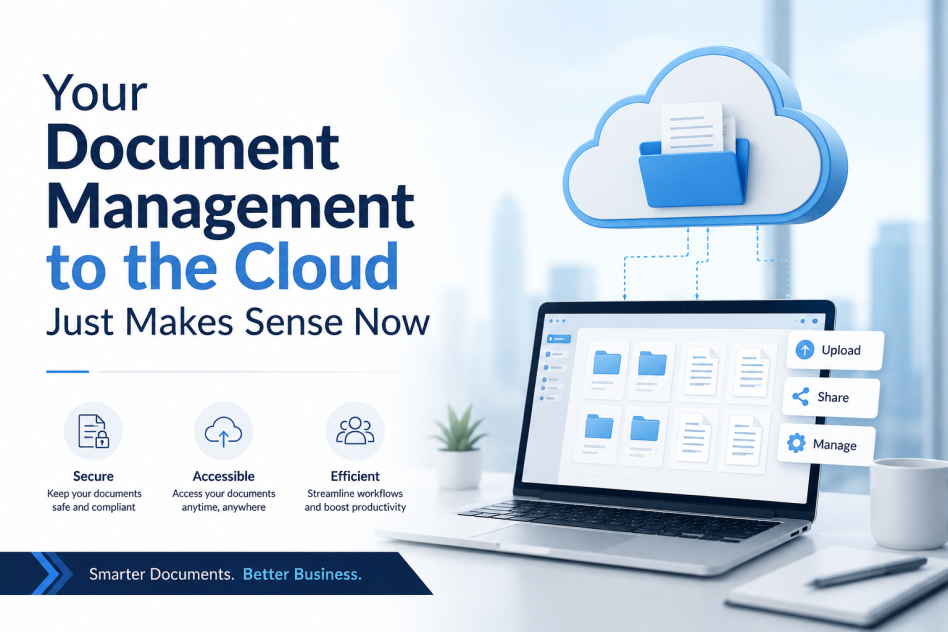
Simply put, a DMS on cloud stores and manages your business documents on remote servers — accessible through a browser or app, from any device, by whoever you've given permission to. Your files aren't sitting on someone's laptop or buried in a shared drive that only two people know how to navigate.
But the real value isn't just access. It's structure. A good cloud DMS gives you:
• Automated document indexing so files are categorized the moment they're uploaded, not when someone gets around to it
• Full version history — every edit tracked, every previous version retrievable
• Granular access controls so the right people see the right documents, and the wrong people don't
• Search that actually works — pull up a contract by client name, date, or a keyword from the body text
That last one is underrated. If you've ever spent twenty minutes searching a shared drive because folders were named inconsistently across three different people's conventions, you already know what I mean.
________________________________________
How Managed Print Services Companies Fit Into This Picture
This is a connection that gets missed more often than it should. A cloud DMS manages documents digitally — but a large portion of business documentation still starts, or ends, as something physical.
Managed print services companies handle the print infrastructure that sits at the center of that physical side. They manage the hardware, the supplies, the maintenance, and increasingly, the workflows that govern how documents move from creation to output. When that print environment is connected to a cloud DMS, you get something genuinely useful: a traceable document lifecycle from first draft to final printed copy.
For businesses running an industrial printer in Dubai — handling volume print work like technical specifications, delivery documentation, large-format drawings — this integration isn't a nice-to-have. It's what prevents documents from falling through the cracks between production and record-keeping. High output environments need high-structure systems. The two go together.
________________________________________
Komidoc: Built for Businesses That Take Documents Seriously
Not every cloud storage tool is a document management system. That distinction matters more than most people realize when they're evaluating options.
Komidoc is built specifically around document workflows — not just file storage. It handles intelligent document capture, metadata-based organization, and process automation in a way that reflects how actual business teams operate. Documents are tied to projects, clients, approval stages, and compliance requirements. Nothing exists in isolation.
For sectors like construction, logistics, legal, or manufacturing, that level of organization isn't a premium feature. It's baseline. The difference Komidoc makes is that the structure comes built-in, rather than something you have to create and maintain manually.
________________________________________
Making the Switch: What to Think About First
Cloud DMS adoption doesn't have to be painful, but it does require a bit of honesty about your actual needs before you commit. A few questions that tend to matter more than people expect:
• How well does it integrate with tools you're already using — ERP, accounting software, CRM?
• Will your team realistically adopt it, or is the interface going to create more resistance than it solves?
• What's the vendor's onboarding process like? A system nobody knows how to use is just expensive shelf-ware.
• How does it handle external document sharing — clients, contractors, partners?
The answers shape everything. A platform that's technically impressive but practically ignored doesn't improve anything.
________________________________________
Final Thought
Document management is one of those operational areas that tends to run quietly in the background — until it doesn't. A solid DMS on cloud isn't a flashy investment, but it's one that pays back steadily over time in hours recovered, errors avoided, and audits that don't become emergencies. If your current setup involves crossed fingers and institutional memory, it's probably time to look at something built for the way your business actually works.
________________________________________
Frequently Asked Questions
Q: What is a DMS on cloud and who genuinely needs it?
A DMS on cloud is document management software that stores, organizes, and provides controlled access to business documents via remote servers. Any business dealing with growing document volumes, multiple team members, compliance requirements, or remote work will benefit — that's most companies past a certain size.
Q: Where do managed print services companies come into a cloud document strategy?
Managed print services companies manage the physical print environment — hardware, supplies, output workflows. When that's integrated with a cloud DMS, documents produced through print operations are automatically captured and stored in the central system, making the entire document lifecycle trackable rather than fragmented.
Q: Is Komidoc practical for mid-sized businesses, or is it built for large enterprises?
Komidoc works across business sizes. Smaller companies get the most immediate benefit from having structure imposed early — before document chaos becomes a real problem. Larger organizations benefit from the workflow automation and compliance features that become essential as complexity grows. It scales with the business rather than requiring a platform switch later.
Quick Details
Reviews
To write a review, you must login first.
From the Same Seller
What Is a B2+ Sheet Fed Printing Press / A Complete Guide for Commercial Printers

Bizhub C360i/C300i | i Series Printer | Saudi Arabia
Color Production Printing: What It Is and Why It Still Matters
Choose the Right Printing Company in Saudi Arabia for Your Business | Konica
Location
Seller Info
